

Protect yourself from disinformation

How to recognize disinformation and protect yourself from manipulation? Discover the techniques and mechanisms behind the spread of false content with the help of experts from the NASK Institute's Disinformation Analysis Center.

Knowledge

What is disinformation?

Contents

Disinformation is false or misleading content. It can take many forms: posts, articles, comments, videos, or audio recordings.

Goals

Disinformation is spread with the intention of deliberately harming the public or generating profit. The ultimate goals of disinformation are to incite fear, distrust institutions, and polarize society.

Dissemination

Each of us can contribute to the spread of disinformation. Simply sharing false content on social media is enough.

Effect

Disinformation undermines trust in public institutions, science, and the media. It contributes to the destabilization of the state and fuels social divisions.

Definitions

What disrupts the flow of information?

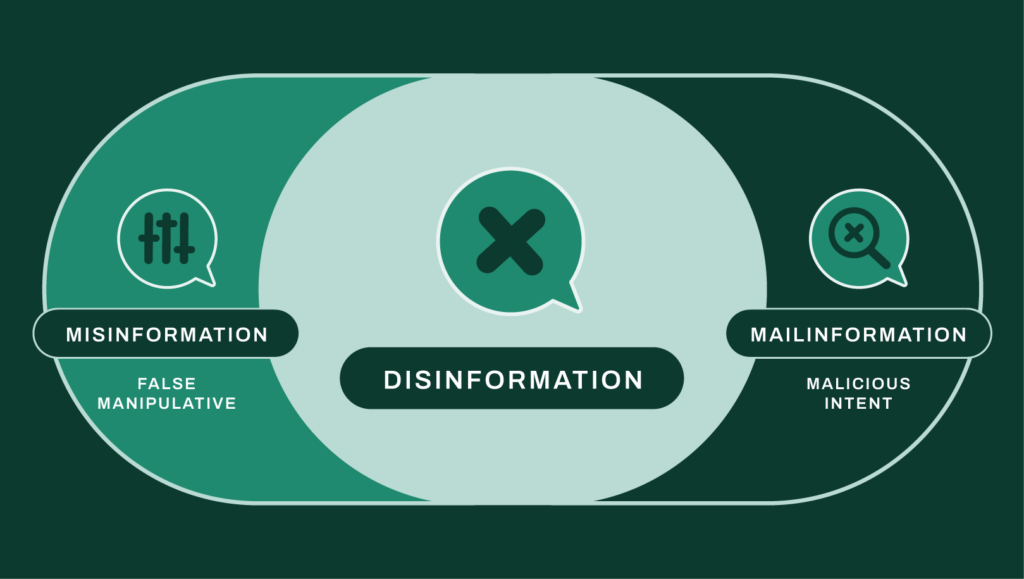
Learn about three key types of communication disruptions: disinformation, misinformation, and malinformation.

Misinformation

False content created and disseminated without the intention to cause harm. It may arise as a result of error or lack of diligence.

Disinformation

False, inaccurate, or misleading content that is designed, presented, and promoted with the intent to deliberately cause public harm or achieve profit.

Malinformation

True content used in a harmful or malicious way to cause harm. It may involve, for example, the disclosure of private information.

Skills

How to recognize a threat?

The internet gives us easy access to information. However, amidst wise advice and proven recipes, there are also false or misleading content. Some of this may constitute disinformation. Learn how to recognize and verify it. Say: I VERIFY!

Think about authors' or sources' intention. Do they want to inform you, sell a product, or influence your views?

Assess the overall context—look for information in other independent and reliable news sources.

Use common sense and evaluate whether the events or figures presented are plausible.

Check who the authors are. Do they exist? Are they reliable experts in their field? Are they known for credible publications?

Consider how the content will influence the public discourse. Will it provoke anger, fear, or conflict among audiences?

Verify whether the source does not omit important facts, take quotations out of context, or manipulate data.

Watch out for clickbaits, exclamation marks, capital letters, and emotional headlines designed to force an immediate click. Be also aware of manipulation techniques e.g., altered images, photomontages, deepfakes.

Threats

Learn the techniques used in disinformation!

Clickbait

A sensational or emotional headline designed to attract attention.

Emotional language

Phrases that evoke fear, indignation, anger or rage.

Impersonation

Using someone's image and authority to spread harmful content.

Cherry picking

Selecting information that fits the thesis while ignoring the context.

False cause

Unjustified assumption of a cause-and-effect relationship between events.

Anecdotal evidence

Citing personal experience to disprove statistics or research results.

Deepfake

Artificial intelligence-generated fake audio or video material.

Cheapfake

Manipulating audiovisual material using simple, widely available tools.

Broadcasters

Who is spreading false content?

Learn more about disinformation actors.

Foreign state services
Foreign state services may deliberately spread disinformation to achieve their goals by influencing the politics, economy, security, or culture of other countries.

Trolls and bots
Trolls are users who post provocative content, while bots are automated accounts that create artificial crowd activity. They may operate in an organized way, within the so-called farms.

Public figures, politicians, opinion leaders, and ordinary users
They may use unreliable data or manipulated information. If they do this without intending to cause harm, we refer to it as misinformation.

Submissions

Protect yourself from disinformation

If you encounter content that appears false or misleading, please report it! Your report can help fight disinformation.

News

Information

NASK part of a Polish-British agreement

News23 July 2026

NASK part of a Polish-British agreement

The weapons of the 21st century are no longer used solely on the battlefield. Conflict has expanded into cyberspace, the internet, and social media. That is why an effective response to foreign influence operations requires cooperation across borders. NASK, together with partners from Poland and the UK Foreign, Commonwealth and Development Office, has signed a cooperation agreement aimed at strengthening information security in Europe.

How does TikTok show China to Polish users?

News21 July 2026

How does TikTok show China to Polish users?

Is what you see on TikTok driven solely by business considerations? A NASK study suggests that the platform’s content recommendation system may contribute to building a favourable image of China. Experts from NASK’s Disinformation Analysis Centre examined nearly 10,000 pieces of content related to six topics considered particularly sensitive by Beijing. The question remains: can the platform’s algorithm influence how China is perceived by Poles?